
Running interviews
This page is for Facilitators who set up and run interviews. It walks through one interview round from start to finish:
- Create a Topic and put it in a group.
- Write the checklist.
- Check who does the interviewing.
- Invite the people you want to interview, inside and outside the workspace.
- Follow the interviews while they run.
- Review, reconcile and send the answers to your Brains: see After the interview.
For what the person being interviewed sees, see Taking an interview. For the matrix and comparing answers item by item, see Checklists & interviews.
Where to configure an interview
There is no separate prompt for each interview. To give the interviewer instructions for every interview on a checklist, use Interviewer instructions at the top of that checklist.
| Setting | What it does | Who can edit | Where |
|---|---|---|---|
| Topic and its group | The channel the interviews live in, and where it sits in the left bar. | Facilitators | Topics page → Create Topic. See Create a Topic. |
| Checklist, sections and items | What every interview should find out. Details says what counts as done. | Anyone who can edit the checklist | Topics page → Checklist. Add an item for new items. Edit details on an item, or on a section header, changes its Details. |
| Checklist order | The interviewer asks required items first, then optional ones, each in checklist order. Sections go in the order of their first item. | Anyone who can edit the checklist | In the checklist, drag the ⠿ handle on an item or a section header, or use ↑ / ↓. Items can move within a section or to another one. |
| Interviewer instructions, whole checklist | How to choose and word questions. Used on every turn of every interview on the checklist. | Facilitators and above | Interviewer instructions, at the top of the checklist. |
| Interviewer instructions, one section | The same, only while the interviewer is on an item in that section. | Facilitators and above | Edit details on the section header → Instructions for the interviewer. |
| Interviewer instructions, one item | The same, only while the interviewer is on that item. | Facilitators and above | Edit details on the item → Instructions for the interviewer on this item. |
| Interviewer's system prompt | How the interviewer agent behaves in every interview it runs, in every Topic. | Admins | Admin → Agents → Edit on the interviewer's row → System prompt. |
| Interviewer's name | The name it introduces itself with. | Admins | Admin → Agents → Edit → Name. See Check who does the interviewing. |
| Welcome notice | A checklist item whose Details tell the interviewer to open with a quoted message is sent as the first message, word for word, and never asked again. | Anyone who can edit the checklist | The item's Details, for example: open with exactly this: "Welcome ...". |
| Voice and phone | Spoken interviews, the AI and recording notice, phone numbers. | Admins | See Voice interviews. |
| Invites and reminders | Who gets an interview, and nudging them. | Facilitators | The Interview's Setup tab → Participants. See Invite people and Bump. |
| Findings during interviews | Whether findings show while an interview is running (findings_during_interviews, off by default). | Facilitators and above | Admin → Workspace → Findings during interviews. |
| Founder answers in Topics | Whether founders' answers in a Topic conversation are graded (topic_conversation_grading, on by default). | Facilitators and above | Admin → Workspace → Founder answers in Topics. |
The SuperAdmin can also tune these platform settings in Admin → Settings:
| Setting key | What it does | Default |
|---|---|---|
interview_guidance_max_chars | The most characters one piece of interviewer instructions may hold. 0 turns interviewer instructions off. | 1500 |
interview_grading_timeout_s | How long grading an answer may hold up the reply, in seconds. | 8 |
topic_conversation_grading_debounce_s | Quiet seconds before a burst of Topic messages is graded together. 0 grades each message. | 0 |
interview_opener_minutes_per_item | Minutes per required item in the opener's "about N minutes". | 5 |
interview_disclosure_template | The interviewer's opening line. | "Hi, I'm {agent}, your AI {interview} assistant for {workspace}." |
interview_recording_notice | The recording notice on voice sessions. | "This voice session is recorded. ..." |
interview_live_window_minutes | How recently the participant must have spoken for the interview to show as live. | 10 |
interview_pause_timeout_minutes | How long a paused interview waits before it is closed with gaps. | 1440 |
Topics
A Topic is a channel whose conversations are interviews. Each Topic has one checklist: the things every interview in it should find out. Each person you add gets their own interview in the Topic. There can be group discussions too.
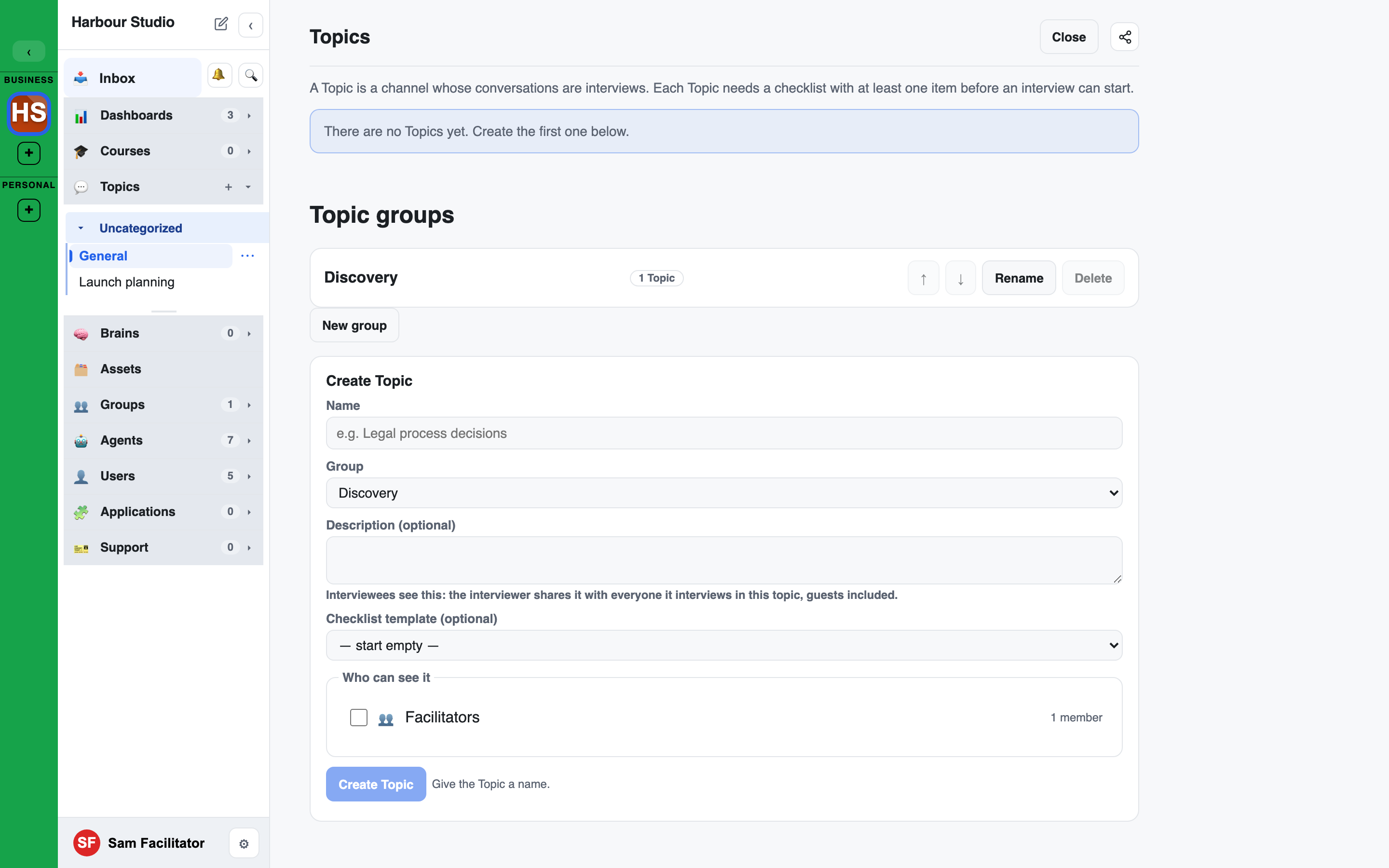
Topics sit in the left bar's Topics section, under their Topic group. The section's … menu has Browse topics, which opens the Topics page.
Interviews have their own section
A Topic with an interviewer agent or a checklist, and a programme week, is an Interview. By default Interviews show in their own Interviews section, above Topics, with their own filter and expand toggles; archived Interviews get their own Archived group inside it. The Topics page lists them under an Interviews heading, then the other Topics under Topics. To keep them in the Topics section, see the interviews_nav_section workspace setting in Workspace settings; each person can override it in Settings → Navigation.
An Interview with one session opens that session directly when you click it in the left bar. Otherwise it lists each interviewee, with their sessions (session 1, session 2, ...) under their name; the + on a person's row starts a new session for them. The Interview's Setup tab lists every participant with their progress.
- + New interview: the + on the Interviews section opens the Create Topic form on the Topics page. The new Topic starts with the workspace's interviewer agent already set, so it is an Interview from the start.
- The Topics +: the + on the Topics section (and the command palette's new Topic) opens the simple New Topic form: Title, an optional Goal and optional Members. The Topic opens in its chat, not on Setup: a Topic is a conversation; an Interview is set up separately.
- A Topic's checklist outside an interview shows progress only. The interviewer's controls (Defer, and confirming, editing or retracting an answer) appear only inside an interview.
1. Create a Topic
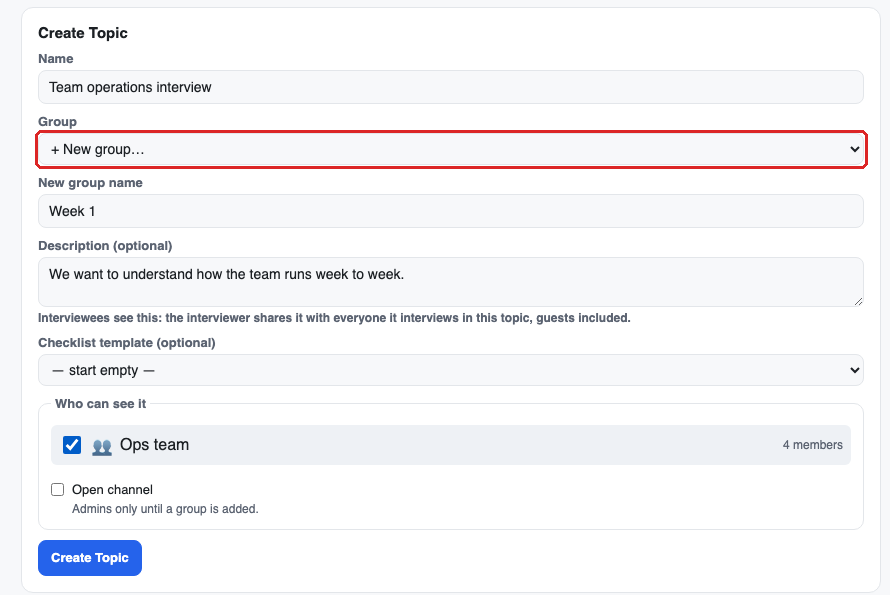
On the Topics page, fill in Create Topic:
- Name: what the interviews are about, for example "Team operations interview".
- Group: the Topic group it sits under in the left bar. Pick an existing group, + New group… to make one (then type its name), or No group (top level).
- Description (optional). Interviewees see this: the interviewer shares it with everyone it interviews in the Topic, guests included.
- Checklist template (optional): start from a saved checklist, or start empty.
- Who can see it: tick at least one group, including one you belong to.
Then press Create Topic. Creating a Topic needs the Facilitator role. The Topic's Setup tab opens next.
You can also turn an existing channel into a Topic: open the channel's ⋯ menu and choose Make this a Topic…. On a Topic, the same menu says Topic checklist.
Setup and Results
Facilitators, admins and SuperAdmins see two tabs on an Interview: Setup and Results. The participant list is at the top of Setup, and Results is the Workbench. Members never see them. In the left nav, the Setup gear shows only on Interviews, never on a plain Topic.
Setup has, at the top, Participants: everyone in the Interview with their progress and status, plus Add participants, Bump, Remove and Reset session for each person. Then Interview agent, How to interview (the interviewer instructions), Interview Context, During the chat (whether Findings show) and the Checklist.
One count
Every interview surface (the live chip, the progress ring, the Progress panel, the left-nav bar, the Workbench and the Review page) reads the same per-item status, so they all show the same count. A drafted answer covers an item; an item the interviewee declined shows as Deferred.
Topic groups
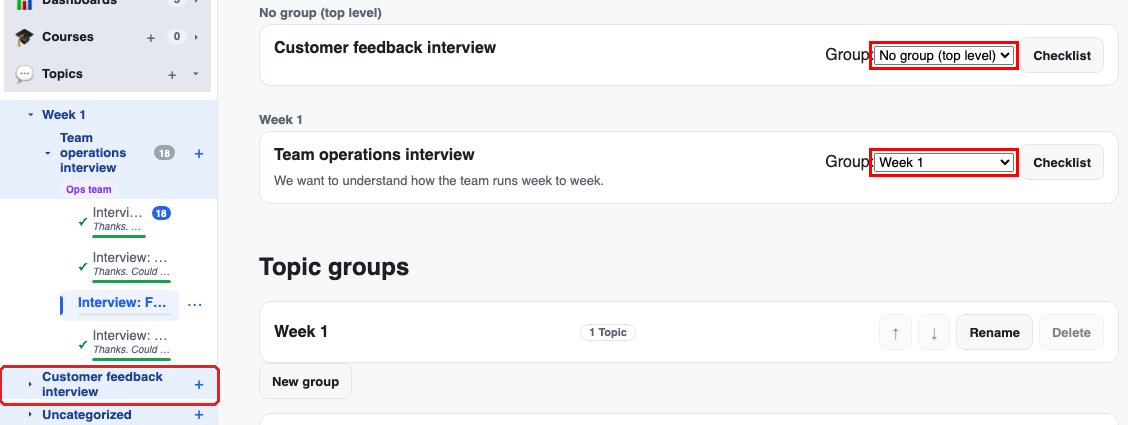
Topic groups keep the left bar tidy, for example one group per week of a programme.
- Move a Topic: each Topic on the Topics page has a Group: menu. Pick another group, or No group (top level) to show the Topic on its own at the top level of the left bar, outside any group.
- Manage groups: under Topic groups, use New group, Rename, Delete (only for an empty group) and the arrows to change the order.
2. Write the checklist
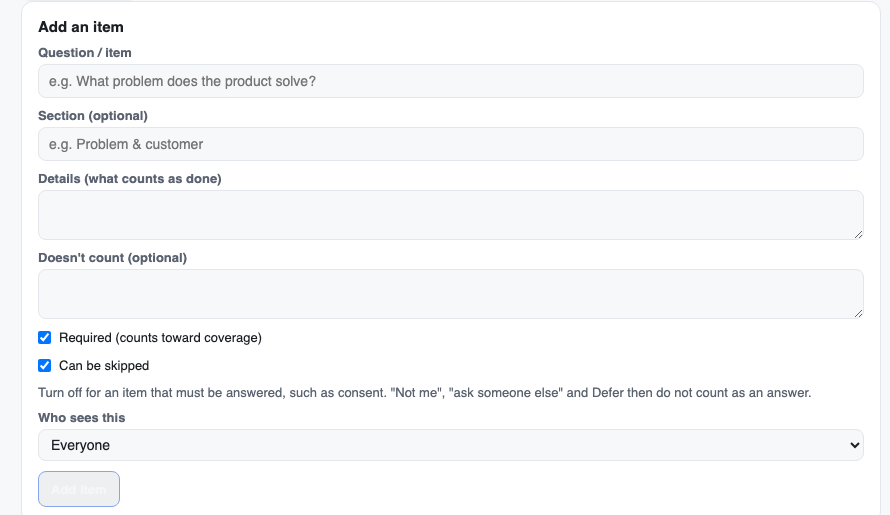
The checklist is what the interviewer works through. Open it from Checklist on the Topics page, or at the bottom of the Interview's Setup tab. Under Add an item, fill in:
- Question / item: what the interviewer should find out.
- Section (optional): to group items.
- Details (what counts as done) and Doesn't count (optional): the interviewer uses these to judge whether an answer covers the item.
- Required (counts toward coverage): ticked by default. Untick it for a nice-to-have. Required items decide whether an interview is complete.
- Can be skipped: turn it off for an item that must be answered, such as consent.
- Who sees this: Everyone, Facilitators only or Participants. The interviewer never asks a Facilitators-only item.
Press Add item for each one.
Edit details on an item, or on a section header, changes its Details.
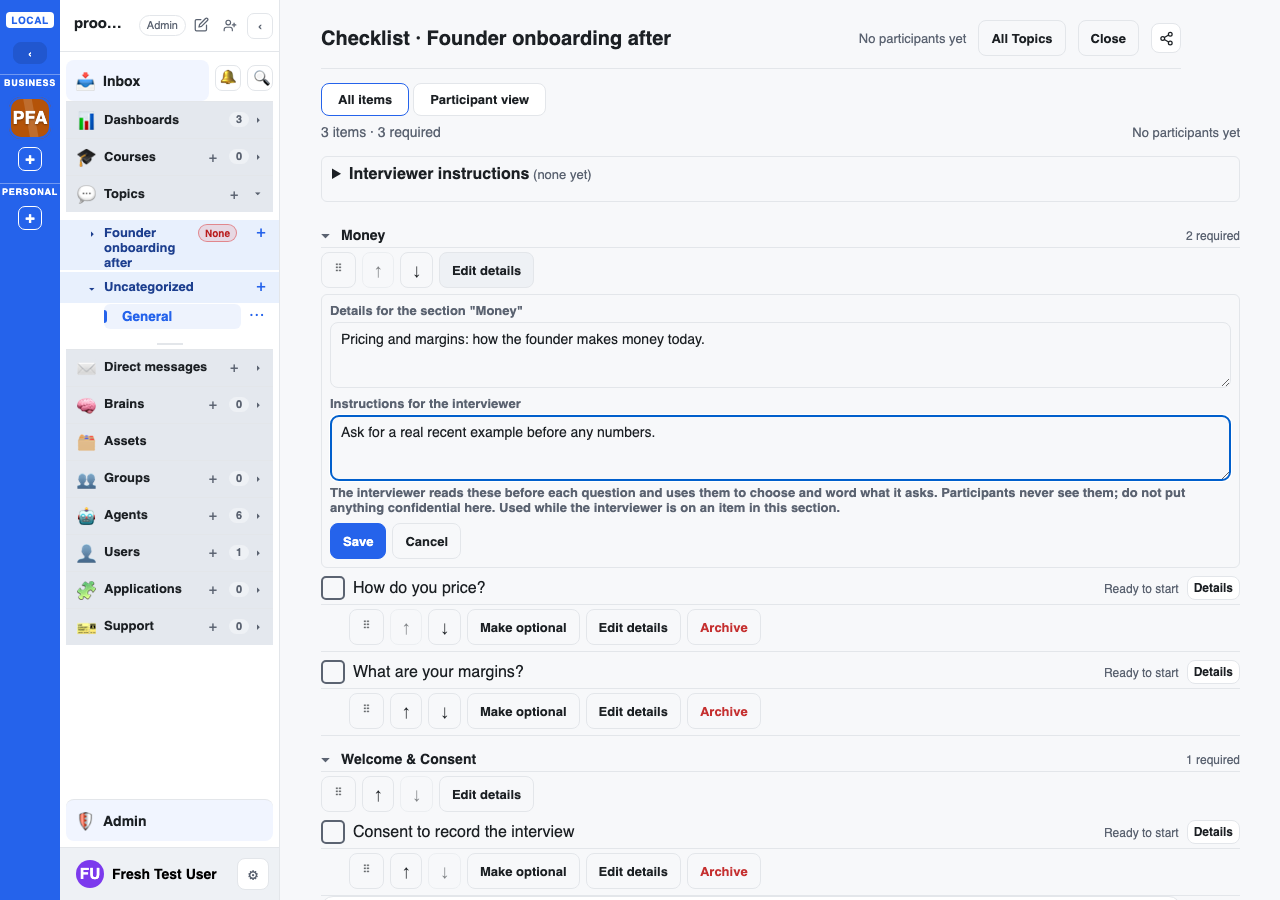
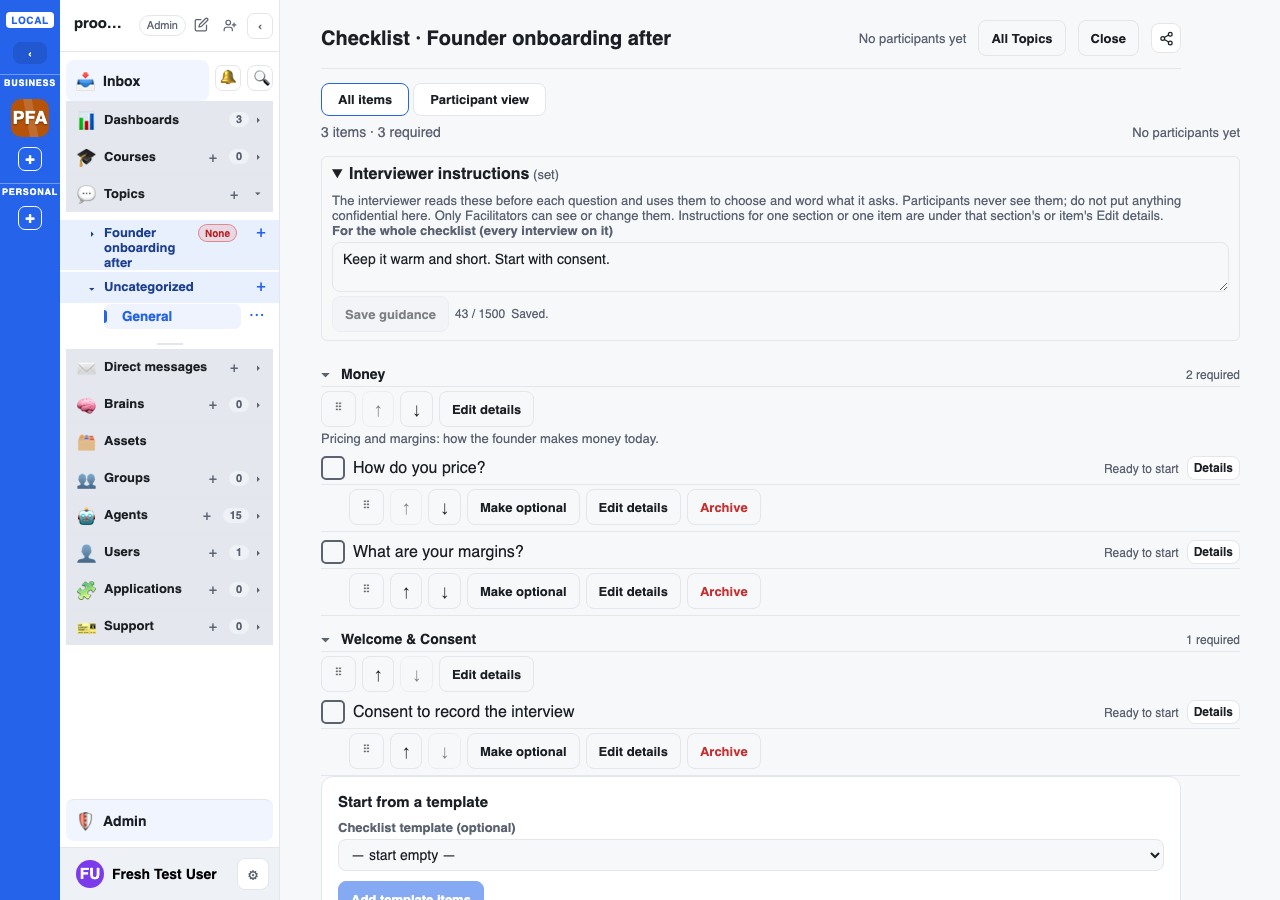
To change the order, drag the ⠿ handle on an item or a section header, or use ↑ and ↓. Items can move to another section. The interviewer asks the required items first, then the optional ones, each in this order.
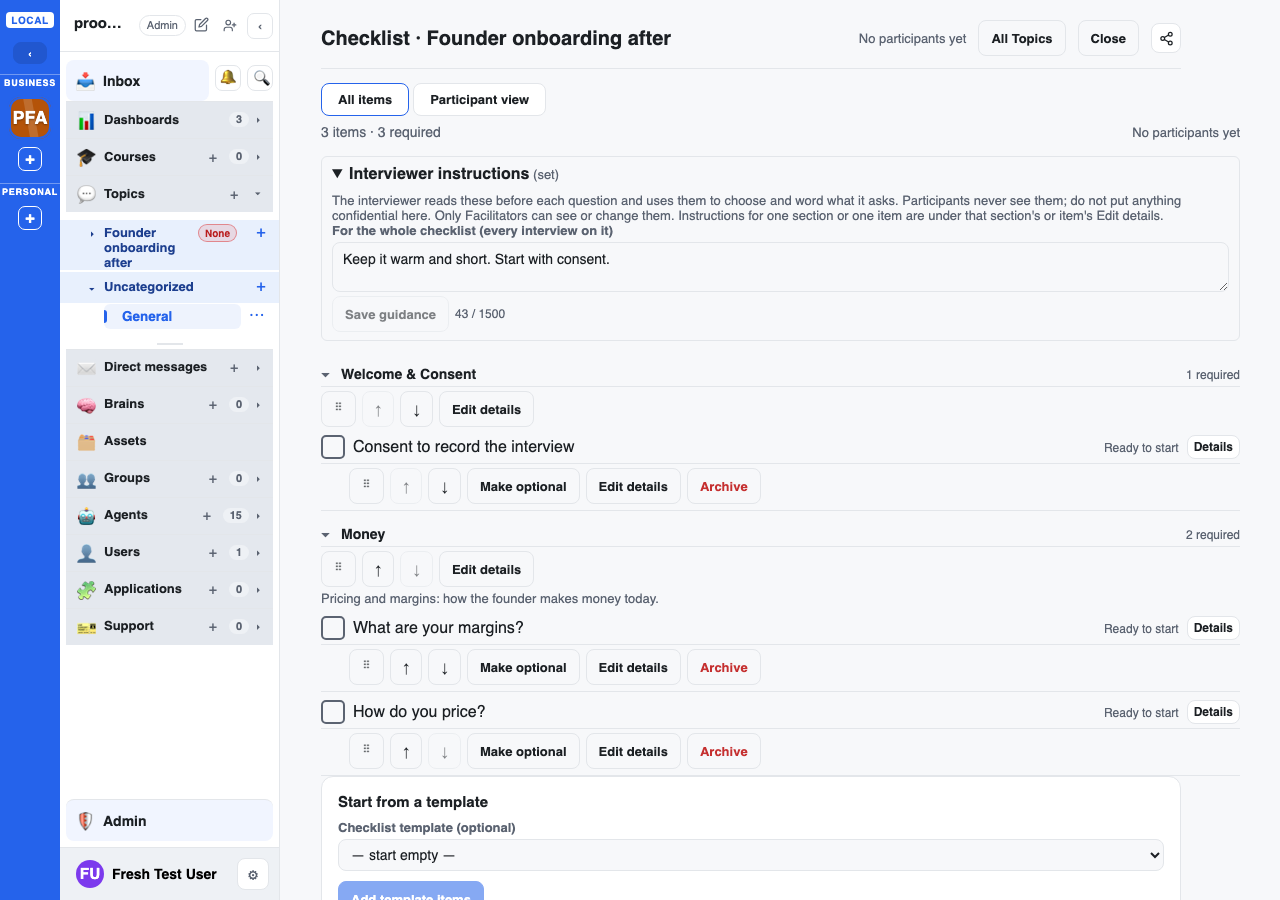
Interviewer instructions, at the top of the checklist, tells the interviewer how to choose and word its questions in every interview on this checklist. A section's or an item's Edit details form has its own instructions too, used only while the interviewer is on that part. Facilitators and above can edit them. They aren't shown on the checklist. Don't put anything confidential there.
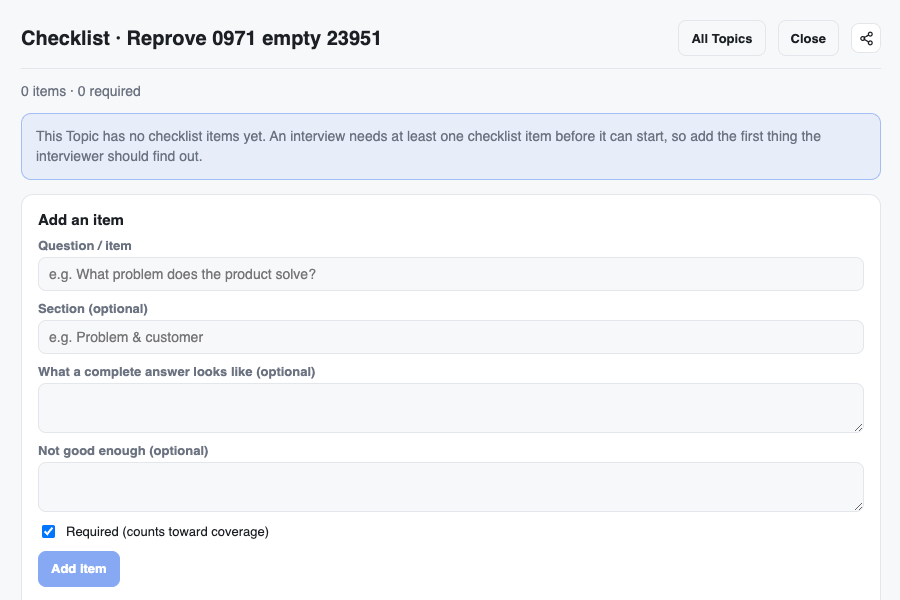
An interview can start as soon as the checklist has any item. With no items there's nothing to ask, so it won't start. The interviewee sees one of these, with a link to fix it:
| What they see | Link |
|---|---|
| This conversation isn't in a Topic, so there's no checklist to interview from. | Open Topics |
| This channel isn't a Topic yet, so there's no checklist to interview from. | Make this a Topic |
| This Topic's checklist has no items yet, so there's nothing to interview from. | Open checklist |
3. Check who does the interviewing
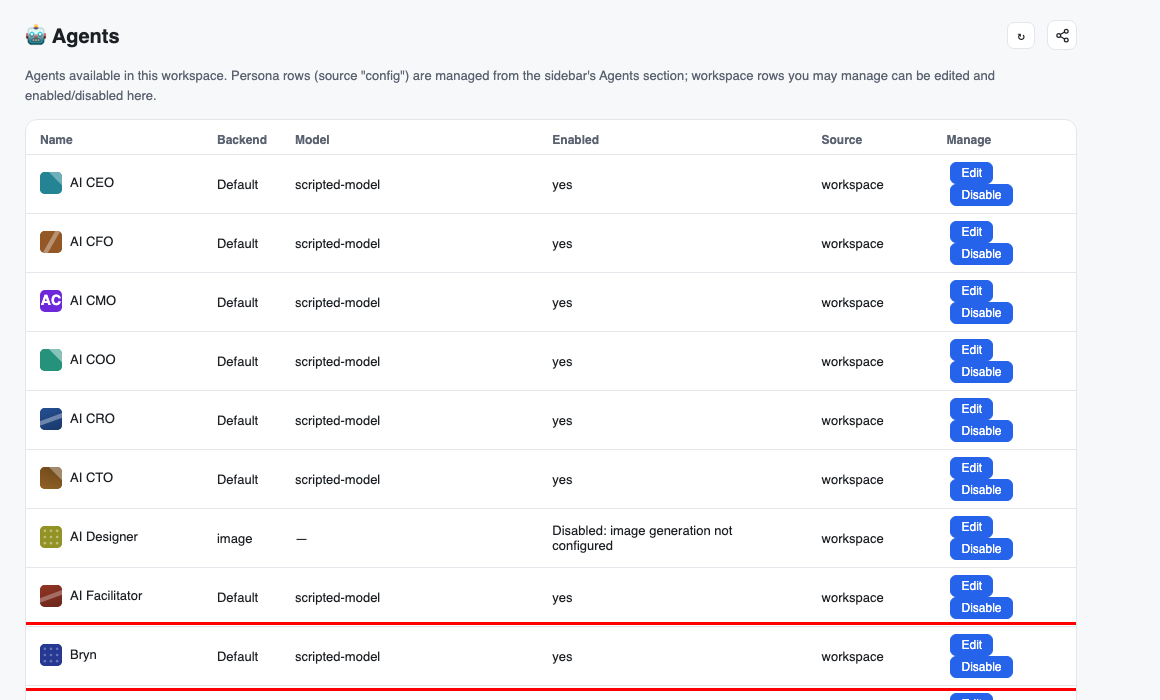
Interviews are run by your workspace's interviewer agent. It introduces itself by name: "Hi, I'm Bryn, your AI conversation assistant for your workspace."
- In a programme workspace that has Bryn, Bryn is the interviewer. There is nothing to set up: the person being interviewed talks to the same Bryn they already know.
- In other workspaces the interviewer is the agent called Interviewer. An Admin can rename it: Admin → Agents → Edit on its row. The new name is the one interviewees see.
- External guests are greeted as "your AI interview assistant for your workspace".
4. Invite people
Open the Interview's Setup tab. Its Participants list has Add participants, Invite external person and New interview group.
People in your workspace
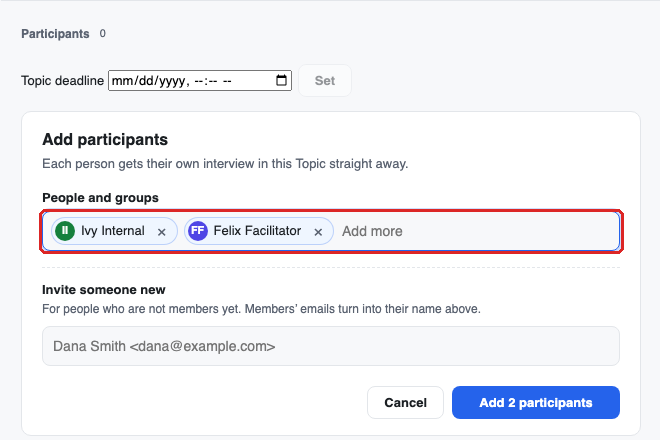
- Press Add participants.
- Under People and groups, type a name and pick the person. Add as many people or groups as you like.
- Press Add N participants.
Each person gets their own interview in the Topic straight away. Someone who isn't a member yet can be invited by email under Invite someone new. See Adding participants to a Topic.
People outside the workspace
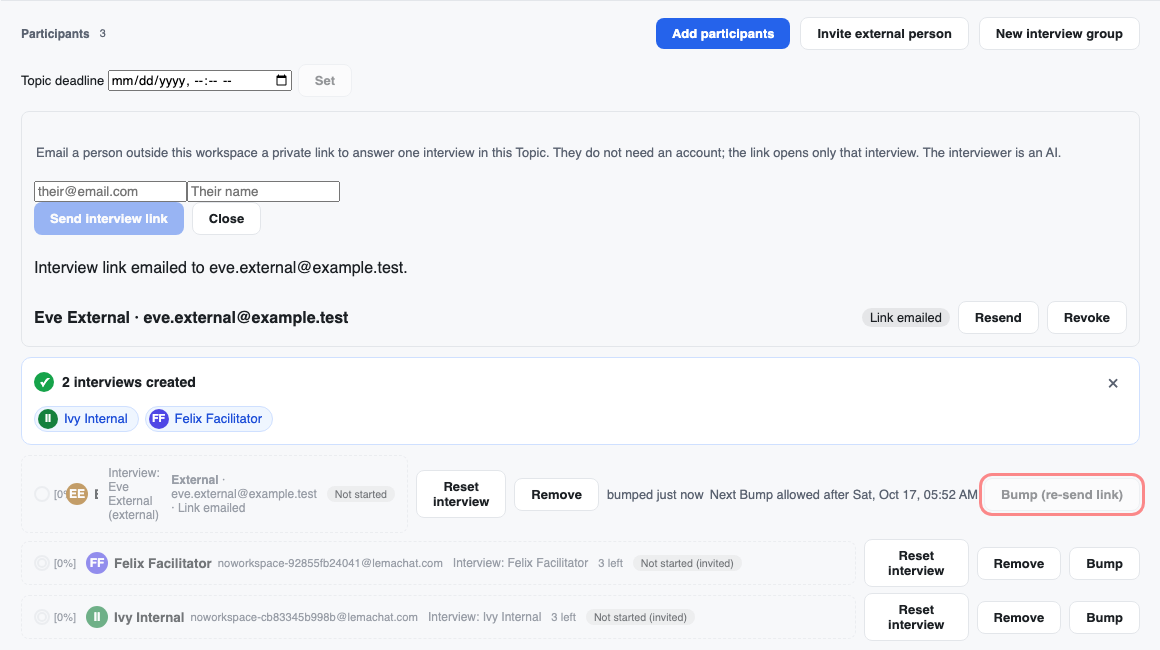
Invite external person emails someone outside the workspace a private link to answer one interview in this Topic. They don't need an account, and the link opens only that interview.
- Press Invite external person.
- Enter their email and name.
- Press Send interview link.
Their row shows External, their email and a status such as Link emailed, Opened the link or Responding. Resend sends the link again and Revoke stops it working.
Bump: a reminder
Bump reminds someone who hasn't finished. A member gets a notification. An external guest gets their link emailed again (the button reads Bump (re-send link)).
- You can bump each person once every 24 hours. After a Bump the row says Next Bump allowed after with the date and time, and the button is greyed out until then.
- A guest keeps Bump while they're answering, until their interview is complete.
- Deadlines can send reminders for you. See Interview deadlines and reconciling answers.
Other row actions
- Reset session gives the person a fresh session (see below).
- Remove takes them out of the Topic. Their interview is archived, not deleted.
Reset session and New session
Each person in Setup's Participants list has Reset session. In the left nav, the + on a person's row in an Interview does the same thing (New session for the person). Both ask twice:
- Start a new session for the person? The interviewer starts it fresh, with clean checklist answers.
- Move the old session to the Trash? OK moves it to the workspace Trash (restorable until the Trash clears it); Cancel archives it (kept, restorable).
Nothing is deleted straight away. Resetting needs the Facilitator role or above, and is audited.
5. Follow the interviews
What the interviewee sees
There's nothing for the interviewee to start. When they sign in they land in their interview (it's under Your interview in their left bar), and the interviewer has already said hello and asked its first question. Guests start the moment they open their link. See Taking an interview.
While they answer:
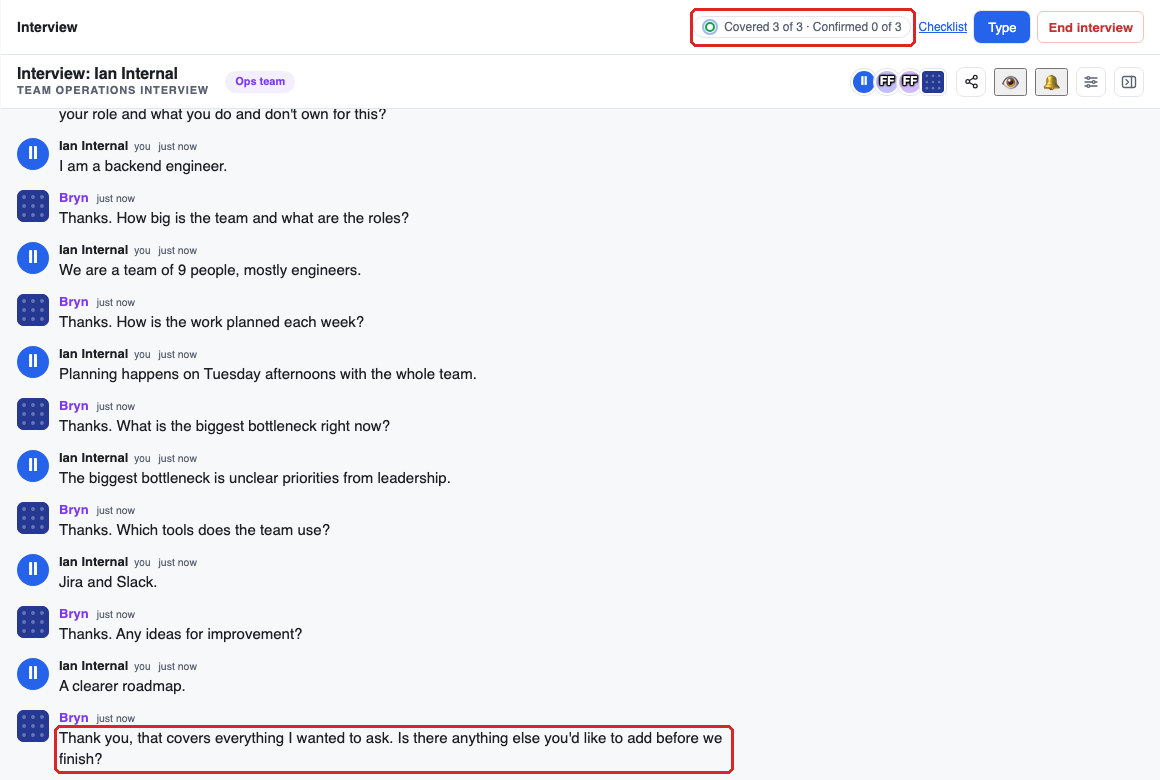
- The progress ring at the top fills in and reads, for example, "Covered 2 of 3 · Confirmed 0 of 3". Covered counts the required items the interview has answered so far. Confirmed counts the ones a Facilitator has confirmed.
- Order: required items first, then optional ones.
- Live drafts: after each answer the interviewer drafts Answers on the checklist. They stay drafts until a Facilitator confirms them.
- Before it finishes, once the required items are covered, the interviewer asks whether there's anything else to add.
How it ends
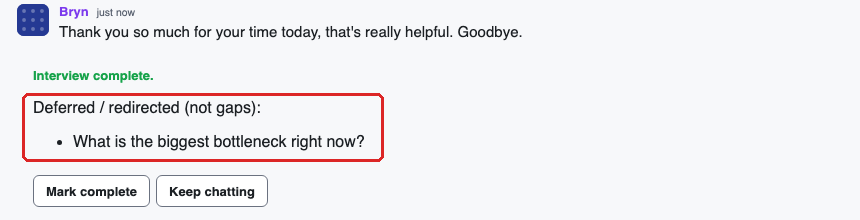
When the interviewee says they're done, the interviewer says goodbye and the panel shows:
- Interview complete. with Mark complete and Keep chatting. Mark complete confirms they're finished; you then see "The interviewee marked this interview complete." Keep chatting picks the interview up again.
- Deferred / redirected (not gaps): items the interviewee passed on, for example "That's not me, ask Fran". These are listed separately and don't count as gaps.
- If required items are still open, the interview ended with gaps and lists what's Still missing.
Interview status
The Participants list on the Interview's Setup tab shows everyone with their progress and a status:
| Status | Notes you may see |
|---|---|
| Not started | invited, invited, not joined, not invited yet, ready |
| In progress | paused |
| Needs review | with gaps, reviewing answers |
| Done | closed by facilitator |
An interview that stopped before the end reads Incomplete, with how much of the required checklist it covered, for example "Incomplete (40% done)".

Steering a live interview
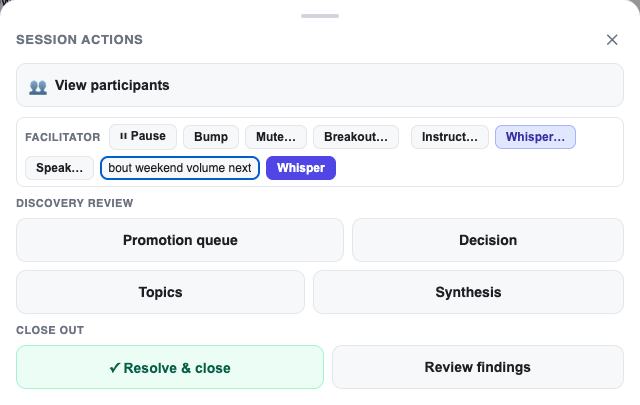
- Whisper to the interviewer: your message bar opens in Message, like every chat. Pick Whisper in the + menu (or reply to a whisper) and what you type goes to the interviewer as a whisper, which the interviewee doesn't see. See Whisper.
- Session actions: open it from the participants control at the top of the chat. Under Facilitator:
- Instruct… gives the interviewer a standing steer.
- Whisper… sends the interviewer a whisper the interviewee doesn't see.
- Speak… makes the interviewer say your words exactly.
Quicklinks
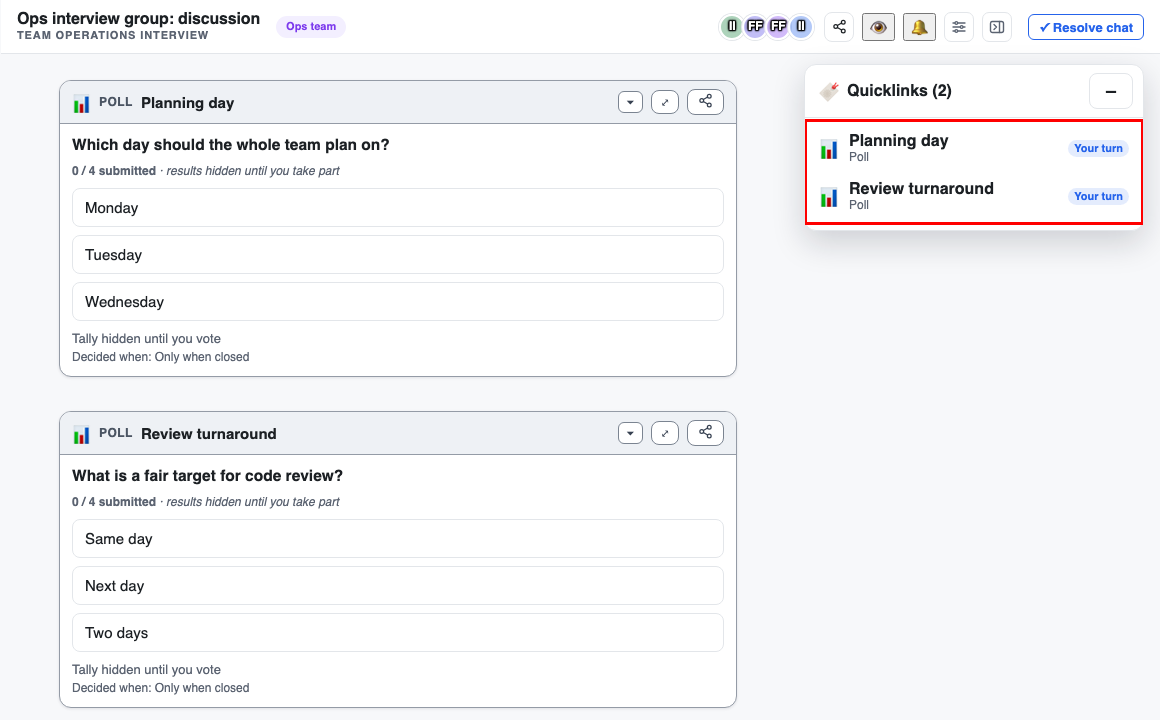
In a chat that has polls or other widgets, a Quicklinks (N) button appears at the top right. It lists the chat's widgets so nobody has to scroll to find them. Press one to jump to it. A widget you still need to answer is marked Your turn, and closed or answered ones sit under Done. This is handy in an interview group's discussion, for example to settle a question with a quick poll.
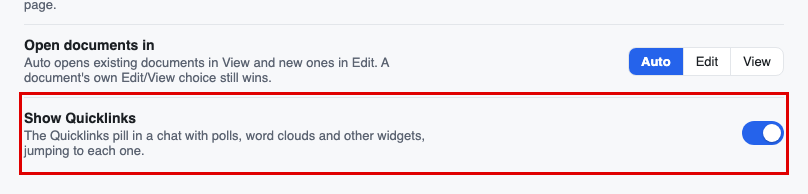
Quicklinks is on by default. Anyone who doesn't want the button can turn it off for themselves in Settings → Chats → Show Quicklinks. The choice follows them to every device and doesn't change what anyone else sees.
Several Facilitators on one Topic
More than one Facilitator can run the same Topic. Each can add people, review interviews and decide answers. The app records who did what:
- confirmed Answers show Confirmed by and the Facilitator's name;
- Brain records show who approved them;
- reconciled answers show who decided them.
Two Facilitators reviewing different interviews never overwrite each other or create duplicate Brain records.
A Facilitator can be interviewed too. For your own interview, switch the role chip next to the workspace name (or Work as in your settings) to Member, so you see what other members see. Switch back afterwards.
Starting an interview another way
Outside a Topic's participant list, a member can start an interview themselves with /interview <subject> (add --voice to start by talking), or by choosing Type or Speak and pressing Start interview. The person who starts it is the interviewee. Everyone else in the chat sees a Viewing tag.
| Mode | How it runs |
|---|---|
| Typed | In the chat itself, typed in the chat's own message bar. A slim bar at the top shows Interview, the checklist and End interview. |
| Voice | In the browser, over the microphone. The interviewee can switch between Type and Speak at any point; it stays one interview with one transcript. |
| Phone | The interviewer calls a phone number. See Phone interviews. |
Voice and phone interviews open by saying the interviewer is an AI and that the session is recorded. The same words show on screen in the browser.
Answers given outside an interview
In a programme workspace, Founders also answer in the Topic's shared conversation. The workspace setting Count founder answers given in the Topic conversation (on by default) checks those answers against the Topic's checklist and counts them toward each Founder's own progress, as interview answers do. Turn it off to count interviews only. Facilitators and Admins can change it in the workspace settings.
Phone interviews
Phone interviews start through the API, not from the message bar. Send POST /api/chats/{chat_id}/interview with the number in international format as the subject:
{ "subject": "+447700900123", "delivery": "phone" }- The number must be a valid international (E.164) number or the call is refused before anything is dialled.
- The same checklist gate applies.
- On a phone call the interviewer works from its instructions and the checklist only. It doesn't search your Brains.
- Your workspace needs voice set up first; see Voice & phone interviews.