
Model & agent sovereignty
Every agent in LEMA Chat carries a plain-language answer to a question most chat tools never let you ask: where does my data actually run? Open any agent's profile and you'll see a short sovereignty line — Platform, Region, Retention, Provider, and Model — so the jurisdiction and data-handling posture of each agent is visible to everyone in the room, not buried in an admin console.
The sovereignty line
Click an agent's name or avatar to open its profile popover. Below the agent's identity you'll find five labelled fields:
- Platform — the host that actually serves the model, which is what sets the legal jurisdiction. For example AWS Bedrock (EU-ZDR) or Anthropic (Claude).
- Region — where that platform runs the request, such as EU (Ireland), or Any region when the platform doesn't pin one.
- Retention — the data-retention posture for that platform-and-region combination: ZDR (zero data retention), No ZDR (~30d), or Not asserted when no claim is on record.
- Provider — the maker of the model (for example Anthropic, OpenAI, Google). This is transparency about who built the model, and is deliberately separate from the Platform that hosts it.
- Model — the exact model identifier the agent runs.
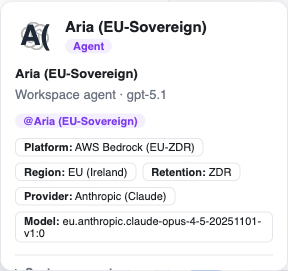
Every value here is read live from the agent's resolved connection and the platform, region, and retention catalogs — never guessed. If a connection points somewhere the catalog can't vouch for, the profile refuses to display a jurisdiction rather than inventing one.
Same maker, different jurisdiction
The reason Platform and Provider are two separate fields is that the same model maker can be reached through very different jurisdictions, and the data-handling consequences are not the same.
Compare two agents that both run an Anthropic-made Claude model:
- Aria reaches Claude through AWS Bedrock in the EU, pinned to EU (Ireland), under zero data retention (ZDR).
- Dexter reaches Claude through the direct Anthropic API, with no ZDR and a retention window of roughly 30 days.
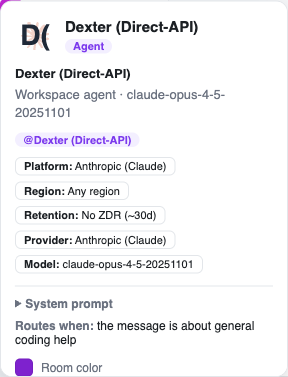
Same maker, same underlying model family — but a different host, region, and retention posture. The sovereignty line makes that distinction impossible to miss, so you always know whether a conversation is staying inside an EU-ZDR boundary or leaving it.
Choosing a compliant model
When an admin edits an agent, the model catalog carries the same sovereignty facts as filters, so a data-residency requirement can drive the model choice directly. Alongside a name filter there are dropdowns for provider, region, and capability, plus a ZDR only toggle — and they compose.
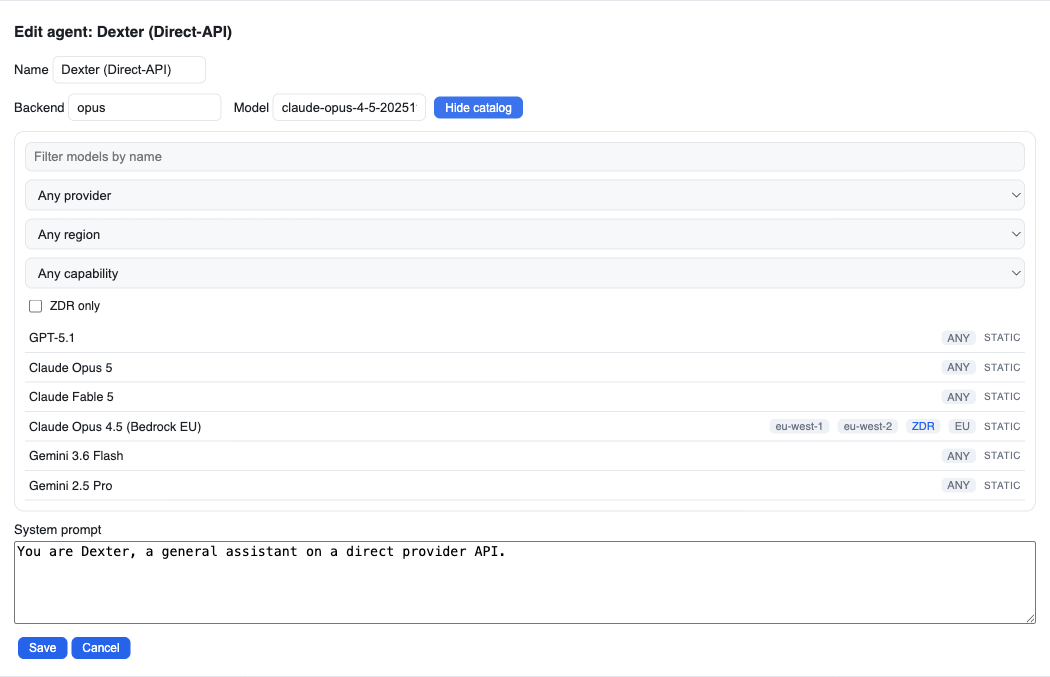
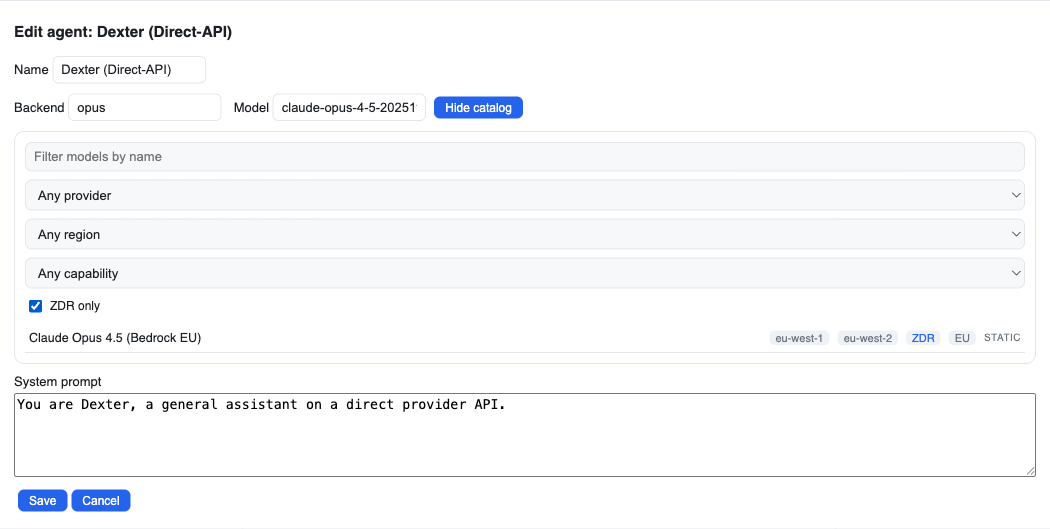
Ticking ZDR only narrows the catalog to models that can run under zero data retention — here, just the Bedrock-EU Claude entry, badged with its eu-west-1 / eu-west-2 regions, a ZDR badge, and an EU badge.
Who sets this up
Which platforms, regions, and connections a workspace uses is an admin capability — see the Admin's Guide and Connections (BYOK). The sovereignty line itself is visible to every member, so anyone can check where an agent runs before they rely on it.